Showing posts with label Black Cinema. Show all posts
Tuesday, August 21, 2012
Jesse Thorn Interviews Black Dynamite's Michael Jai White & Carl Jones
Jessie Thorn of Bullseye talks to the duo behind Black Dynamite: The Animated Series, about their favorite Blaxploitation movies and how they influenced the movie. They also give a little background on the Richard Pryor episode, "Get Him To The Sunset Strip".
Labels:
adult swim,
Black Cinema,
Black Dynamite,
movies,
Podcasts,
Television
Sunday, June 3, 2012
Oh No - 3 Dollars (Featuring MF DOOM) (Music Video)
3 Dollars will be featured on Oh No's forthcoming release, Ohnomite.
About Ohnomite from press release:
Oh No (born Michael Jackson; younger brother of Madlib and son of singer Otis Jackson) was granted unprecedented access to the Rudy Ray Moore / Dolemite audio archives and given free rein to slice, dice, chop and sample his way through the classic-yet-absolutely-filthy catalog. He was able to use legendary material from The Human Tornado, Petey Wheatstraw, the Dolemite Soundtrack and more, plus a multitude of previously unreleased and alternate acapellas and instrumentals. The end result is Ohnomite (available on 6-5-2012), a 19 track head-banging extravaganza of sloppy funk, dirty soul, and brainy lyricism, all aimed at one thing- making your head nod and your ass shake. And when you add to that guests spots from the likes of Evidence, Phife Dawg, The Alchemist, Erick Sermon, Rapper Pooh, MED, Guilty Simpson, Roc Marciano, Sticky Fingaz, Chino XL, Roc C, Prozack Turner, Termanology, Frank Nitt and this cut with MF Doom “3 Dollars.”
Labels:
Black Cinema,
MF Doom,
movies,
Music Video,
Oh No
Thursday, July 21, 2011
Tuesday, April 26, 2011
Monday, April 18, 2011
Monday, April 4, 2011
Random Geekery: Preview Of Black Dynamite Comic Book
Press Release
Ape Entertainment, in partnership with Ars Nova, is proud to announce the release of the original 48 page one-shot Black Dynamite: Slave Island, inspired by the major motion picture BLACK DYNAMITE.
Labels:
Black Cinema,
Black Dynamite,
Comics,
movies,
Random Geekery,
S.T.M.I.O.M.
Friday, April 1, 2011
The Whitewashing Of Mixed (Black) Women In Hollywood
I must confess that it's something that has always irked me to a degree. I've discussed this in the past in regards to Maya Rudolph and her movie, Away We Go. Lately, we seem to routinely be given the pairing of a white man with a racially ambiguous woman with no family of her own or friends that aren't white. Recently I went to the movies and was once again slapped in the face with this recurring theme when I saw the poster for her latest project, Bridesmaids. As dismayed as I was and currently am my feelings for Maya haven't changed from my original blog entry. So, due to my feelings for her and the fact that the trailer is hilarious, I will more than likely be at my local theater dealing with my ambivalence as best I can.
The inspiration for this entry came from an article on Rashida Jones "passing" through Hollywood. In the piece the writer cites a quote from Ms. Jones in Racialicious:
Labels:
Black Cinema,
Black Community,
Maya Rudolph,
movies,
Race,
Rambling Man,
Rashida Jones,
Television
Wednesday, February 23, 2011
IFC Sits Down With "Night Catches Us" Director Tanya Hamilton
A Spirited Q & A With "Night Catches Us" Director Tanya Hamilton
The Best First Feature nominee on capturing the revolution of the Black Power movement in a quiet way.
by Stephen Saito
As a way of celebrating this year's nominees for the Spirit Awards in the weeks leading up to the ceremony, we reached out to as many as we could in an effort to better understand what went into their films, what they've gotten out of the experience, and where they've found their inspiration, both in regards to their work and other works of art that might've inspired them from the past year. Their answers will be published on a daily basis throughout February.
If you didn't know Tanya Hamilton was a painter long before she ever studied filmmaking, you'd probably guess it roughly 15 minutes into her debut film "Night Catches Us." In her Spirit Award nominee for Best First Feature, Hamilton does something extraordinary with what is ostensibly a period piece about two former Black Panthers trying to find their way in the years after the movement's dissipated -- she turns the ordinary into art. Told in glances as much as words, the story is one deeply rooted in history and yet isn't inhibited at all by it, and surely not in the way its main characters are.
That past is brought to the fore when a picture of Marcus (Anthony Mackie), Patricia (Kerry Washington) and her late husband Neal falls from the pages of a comic book that Patty's daughter (Jamara Griffin) flips through, which coincides with Marcus' return to Philadelphia for his father's funeral. Neal's death hasn't been explained to his daughter, nor does Hamilton seem to be in a rush to share it with the audience, letting it linger as just one of the many aspects of a time that's largely uncertain. Neither Marcus or Patricia are entirely the idealists they once were -- they can't afford to be -- though each are still headstrong in a world where there still isn't racial equality.
The true beauty of "Night Catches Us," aside from the elegant cinematography of David Tumblety and musical flourishes from The Roots, is how it presents such complex emotions in such a simple way. Having two of this generation's finest actors in Mackie and Washington certainly doesn't hurt, but the film is particularly striking in the way it drops in archival footage, bits of animation, and static shots of the working-class Philadelphia neighborhood where it's set to capture the essence of the era without overwhelming the story at hand, which is akin to a tale of two lions forced to consider captivity. Whether its characters can ever break free is the central question of the film, but in terms of its own independent spirit, "Night Catches Us" answers with a resounding yes.
Why did you want to make this film?
I'm very interested in that section of time. I think that period of history is so interesting and there's something tragic and romantic and kind of beautiful about that whole Black Power era. It's not my history, but I was definitely interested in how the idea of revolution in a way might affect these people and I was trying to figure out a way to look at it from the aftermath of the movement and to look at it from this very mundane, ordinary perspective.
What was the best piece of advice you received prior to the making of the film?
The best piece of advice probably comes from my husband who's a fiction writer and really encouraged me to focus in on the minutiae of the world and also to look at the small moments rather than anything big and dramatic. That's something that I'm very inclined to be interested in anyway, but also, it's something that I kept with me throughout making the film, both how I directed it and how it was cut and sort of visually.
What was the toughest thing to overcome, whether in a particular scene or the film as a whole?
It may be a very cliché answer, but I think it was money. It really does dictate so much of what either gets done or doesn't get done. Maybe a nicer answer is I had to cut the screenplay down from 125 pages roughly to some place in the eighties. And that was obviously because of money. We had a very tiny budget to shoot it and so it was tough to have to do that, but in an odd way actually, I think it was good. I made some mistakes -- I can see them -- but in general, I think the film ended up being stronger because of it.
What's been the most memorable moment while you've traveled with the film, either at a festival or otherwise?
I had a woman come up to me, I think, in Chicago who was probably in her seventies and was just such a regular working woman and she said that she liked the film a lot. She felt there were some problems with it, but overall she liked it. And I appreciated having this woman who is part of a demographic...these kinds of movies don't always speak to that kind of demographic. I think the movies sometimes can also be narrow in their scope. And I appreciated that this woman came to see it and it resonated with her and I appreciated that she was honest to say she thought there were problems with it, but that she connected with the characters in the world. I felt very heartened by it.
What's your favorite thing about your film that's largely been uncommented upon?
I love the visual language of it a lot. I love the work that David Tumblety, who shot it, did - I think he's an artist. I think as artists we were both able to work really well together and I love the way it looks and I love the small visual moments. That kind of goes back to that minutiae. I love many things about it, but I love the language a lot.
What's been the most gratifying thing to come out of this film for you personally?
I think that probably the most gratifying part, beyond getting to work with people I really like a lot and building a little bit of a quasi-creative family, is that I got to show the film to so many people across the U.S. and that I was able to have so many conversations with ordinary people and the varied arc of the people, whether it was the kind of people who are very much part of the audience for movies like this or people who are completely not in any way. I loved the scope of that. I loved hearing what they had to say, positive and negative, and I think it broadened my sense of what an audience is and how important an audience is, which is something I didn't actually, frankly, recognize before making it.
What's been your favorite film, book or album from the past year?
I have a four-year-old, so I sadly don't ever get out to see movies anymore. That's sort of pathetic. Maybe a book is more appropriate and it's a book I had not read before and found really fascinating. It's a book called "The Intuitionist
" by Colson Whitehead that is a marvelously brilliant book, a metaphor about race and politics and I really liked it a lot.
"Night Catches Us" is now available on DVD and Blu-ray. The Spirit Awards will air on IFC on February 26th.
The Best First Feature nominee on capturing the revolution of the Black Power movement in a quiet way.
by Stephen Saito
As a way of celebrating this year's nominees for the Spirit Awards in the weeks leading up to the ceremony, we reached out to as many as we could in an effort to better understand what went into their films, what they've gotten out of the experience, and where they've found their inspiration, both in regards to their work and other works of art that might've inspired them from the past year. Their answers will be published on a daily basis throughout February.
If you didn't know Tanya Hamilton was a painter long before she ever studied filmmaking, you'd probably guess it roughly 15 minutes into her debut film "Night Catches Us." In her Spirit Award nominee for Best First Feature, Hamilton does something extraordinary with what is ostensibly a period piece about two former Black Panthers trying to find their way in the years after the movement's dissipated -- she turns the ordinary into art. Told in glances as much as words, the story is one deeply rooted in history and yet isn't inhibited at all by it, and surely not in the way its main characters are.
That past is brought to the fore when a picture of Marcus (Anthony Mackie), Patricia (Kerry Washington) and her late husband Neal falls from the pages of a comic book that Patty's daughter (Jamara Griffin) flips through, which coincides with Marcus' return to Philadelphia for his father's funeral. Neal's death hasn't been explained to his daughter, nor does Hamilton seem to be in a rush to share it with the audience, letting it linger as just one of the many aspects of a time that's largely uncertain. Neither Marcus or Patricia are entirely the idealists they once were -- they can't afford to be -- though each are still headstrong in a world where there still isn't racial equality.
The true beauty of "Night Catches Us," aside from the elegant cinematography of David Tumblety and musical flourishes from The Roots, is how it presents such complex emotions in such a simple way. Having two of this generation's finest actors in Mackie and Washington certainly doesn't hurt, but the film is particularly striking in the way it drops in archival footage, bits of animation, and static shots of the working-class Philadelphia neighborhood where it's set to capture the essence of the era without overwhelming the story at hand, which is akin to a tale of two lions forced to consider captivity. Whether its characters can ever break free is the central question of the film, but in terms of its own independent spirit, "Night Catches Us" answers with a resounding yes.
Why did you want to make this film?
I'm very interested in that section of time. I think that period of history is so interesting and there's something tragic and romantic and kind of beautiful about that whole Black Power era. It's not my history, but I was definitely interested in how the idea of revolution in a way might affect these people and I was trying to figure out a way to look at it from the aftermath of the movement and to look at it from this very mundane, ordinary perspective.
What was the best piece of advice you received prior to the making of the film?
The best piece of advice probably comes from my husband who's a fiction writer and really encouraged me to focus in on the minutiae of the world and also to look at the small moments rather than anything big and dramatic. That's something that I'm very inclined to be interested in anyway, but also, it's something that I kept with me throughout making the film, both how I directed it and how it was cut and sort of visually.
What was the toughest thing to overcome, whether in a particular scene or the film as a whole?
It may be a very cliché answer, but I think it was money. It really does dictate so much of what either gets done or doesn't get done. Maybe a nicer answer is I had to cut the screenplay down from 125 pages roughly to some place in the eighties. And that was obviously because of money. We had a very tiny budget to shoot it and so it was tough to have to do that, but in an odd way actually, I think it was good. I made some mistakes -- I can see them -- but in general, I think the film ended up being stronger because of it.
What's been the most memorable moment while you've traveled with the film, either at a festival or otherwise?
I had a woman come up to me, I think, in Chicago who was probably in her seventies and was just such a regular working woman and she said that she liked the film a lot. She felt there were some problems with it, but overall she liked it. And I appreciated having this woman who is part of a demographic...these kinds of movies don't always speak to that kind of demographic. I think the movies sometimes can also be narrow in their scope. And I appreciated that this woman came to see it and it resonated with her and I appreciated that she was honest to say she thought there were problems with it, but that she connected with the characters in the world. I felt very heartened by it.
What's your favorite thing about your film that's largely been uncommented upon?
I love the visual language of it a lot. I love the work that David Tumblety, who shot it, did - I think he's an artist. I think as artists we were both able to work really well together and I love the way it looks and I love the small visual moments. That kind of goes back to that minutiae. I love many things about it, but I love the language a lot.
What's been the most gratifying thing to come out of this film for you personally?
I think that probably the most gratifying part, beyond getting to work with people I really like a lot and building a little bit of a quasi-creative family, is that I got to show the film to so many people across the U.S. and that I was able to have so many conversations with ordinary people and the varied arc of the people, whether it was the kind of people who are very much part of the audience for movies like this or people who are completely not in any way. I loved the scope of that. I loved hearing what they had to say, positive and negative, and I think it broadened my sense of what an audience is and how important an audience is, which is something I didn't actually, frankly, recognize before making it.
What's been your favorite film, book or album from the past year?
I have a four-year-old, so I sadly don't ever get out to see movies anymore. That's sort of pathetic. Maybe a book is more appropriate and it's a book I had not read before and found really fascinating. It's a book called "The Intuitionist
"Night Catches Us" is now available on DVD and Blu-ray. The Spirit Awards will air on IFC on February 26th.
Labels:
Black Cinema,
Black Community,
movies,
Night Catches Us,
Race,
Tanya Hamilton
Monday, February 14, 2011
Guest Blog - Invisible Woman's Take On The Busters *cough* Oscars
OK, after months of speculation, the Oscar nominees have arrived. How many of you were satisfied with the lists?
I, for one, have stopped taking the Oscars seriously years ago; it is such an elitist and "inside" group, and we all should know by now that the politics involved have people winning awards that really have no business doing so. They throw out a bone every few years to someone that is Black, and it is always hailed and regaled as a "victory" to open doors, but afterward we are once again subjected to a few more years of complete and total white-washing. But it has gone beyond that...where are the accolades for Latinos? For Asians? For Eastern Indians?
Hollywood never, ever, EVER seems to understand that diversity makes life (and their lame awards show) interesting. Everyone remembers Monique winning last year, but can you name three others (be honest)?
There is an old saying that I have always remembered, taken from an ancient Chinese philosophy book, and it applies to the Academy in volumes:
"Diversity is actually an important and necessary ingredient, which adds creative spice to a group."Film is universal! The stories told in ANY film are relevant to a good portion of the population, regardless of race. Until Hollywood and the Academy can get this through their heads, I am down with the mission of AFFRM. If you don't know what AFFRM is, please click here and support! And oh yeah, I will NOT be watching the show this year...cheers!
UPDATE: Please check out CNN's article on this issue...the comments over there are sincerely pathetic and sad, and will boggle the mind. I am convinced, more than ever before, that we are completely unsupported in Hollywood, and must step away from the studios and an intolerant audience in order to have a system that allows us to create and be heard. Racism in conventional Hollywood is apparently NOT disappearing anytime soon, and has zero interest in doing so.
If you would like to read more of Invisible Woman's thoughts on cinema, check her out at Black Cinema At Large.
Thanks for stopping by,
8
Labels:
Black Blogs,
Black Cinema,
Invisible Woman,
movies,
Race,
Television
Monday, January 17, 2011
Fortilive - Jim Kelly [Prod. by !llmind] (Featuring Skyzoo)
Labels:
Black Cinema,
Fortilive,
Illmind,
Skyzoo
Tuesday, January 11, 2011
An Article On Tyler Perry That I Wish I Had Written
I know that this review of Tyler Perry's For Colored Girls is more than a few months old, but I decided to post this article because it did a great job of articulating some of the strong feelings that I have for Mr. Perry's work in general. I also find Cortland Milloy to be an unbelievable columnist.
I've never stepped foot in DC a day in my life, but I usually make it a point to check WashingtonPost.com for his work. He has a point of view that definitely seems to be underrepresented and under-appreciated in television, radio, print or online media.
*Artwork courtesy of Tatyana Fazlalizadeh
I've never stepped foot in DC a day in my life, but I usually make it a point to check WashingtonPost.com for his work. He has a point of view that definitely seems to be underrepresented and under-appreciated in television, radio, print or online media.
For Black Men Who Have Considered Homicide After Watching Another Perry Movie
By Courtland Milloy
Washington Post Staff Writer
Monday, November 8, 2010
Can anyone name a movie that came out recently starring a black man who wasn't a sociopath? Someone who had a terrific screen presence, like a young Paul Robeson? And he portrayed a character who was complex and fully drawn? Did he respect black women, too?
Anybody see that movie? I didn't. But surely it's out there somewhere, right? An alternative to those Tyler Perry films portraying black men as Satan's gift to black women? But where is it?
Maybe I didn't hear about it because of all the buzz over Perry's "For Colored Girls," which opened Friday and is based on Ntozake Shange's 1975 stage play, "For Colored Girls Who Have Considered Suicide When the Rainbow is Enuf."
Or maybe I didn't hear about it because I was retching too loudly after seeing "For Colored Girls" - and reading so many inexplicably glowing reviews.
"This movie is powerful," Demetria L. Lucas wrote recently in Essence, the nation's premier magazine for black women. "It is incredible. The performances in it are astonishing, but most of all, this film will leave you lifted."
Me, I thought the movie should have been renamed: "For Black Men Who Have Considered Homicide After Watching Another Perry Movie."
"Oscar buzz, breaking news," read the Hollywood Reporter on Friday. "Will 'For Colored Girls' blindside Tyler Perry's critics?"
Too late. I was blindsided while watching the movie, especially when superstar Janet Jackson appeared onscreen looking like Michael Jackson with breast implants.
"Don't laugh," says Shadow and Act, an online publication about black films and filmmakers. " 'For Colored Girls,' an Oscar contender?"
Oscar for what?
In the category for best infection of a black woman with a sexually transmitted disease that renders her infertile. . . . And the winner is: black man.
For best down-low, double-dealing husband who has sex with wife while sneaking around having sex with men on the streets. . . . And the winner is: black man.
For best portrayal of a guy who at first seems nice but turns out to be a rapist. . . . And the winner is - OMG, his third of the night - black man!
"You may need some time alone after viewing 'For Colored Girls,' " wrote Tonya Pendleton for BlackAmericaWeb.com. "Whatever you may think of the fact that it was Tyler Perry who finally brought the award-winning 1974 Ntozake Shange stage production to the big screen, it will move you."
So will ex-lax.
"You will want to know that two kids get thrown out the window by their father," wrote Jane Nosonchuk for Hamptonroads.com. "The scene is well done."
Do I hear another Oscar nomination?
"The men in the movie are all bad guys except for the cop," Nosonchuk wrote. "They are a means to an end rather than any lead characters. Also, a back-room abortion may disturb some."
You think?
What an awful year for movies featuring black actors. Samuel L. Jackson in "Unthinkable." Thoughtless would be more like it. "Brooklyn's Finest" had a nice cast, with Don Cheadle and Wesley Snipes. But Richard Gere and Ethan Hawke got top billing. "Our Family Wedding" with Forrest Whitaker was okay. But how many black wedding comedies can you watch? Even preacher T.D. Jakes is coming out with his own copycat wedding movie next year.
Surely Spike Lee and Denzel Washington could team up for a sweeping historical drama - say, a black sharecropper's son, educated in a one-room schoolhouse built by slaves in Alabama, who grows up to become one of Wall Street's most powerful CEOs.
Smarter than Gordon Gekko and more complex. With a cameo appearance by former Merrill Lynch chief executive Stanley O'Neal.
Maybe you saw the kind of movie I'm talking about. If not, maybe it's time to make one.
milloyc@washpost.com
*Artwork courtesy of Tatyana Fazlalizadeh
Labels:
Black Cinema,
Black Community,
movies,
Tatyana Fazlalizadeh
Wednesday, November 10, 2010
Black Dynamite Coming To Adult Swim & Comic Book Stores
Fans of the film will feel right at home with the comic, states Ape Entertainment founder and co-publisher Brent E. Erwin. It has all of the elements that made the movie a cultural phenomenon, and Black Dynamite himself is still as much of a bad dude on the page as he is on the screen.Comic news courtesy of Ape Entertainment.
Directed by Scott Sanders, the film premiered at the Sundance Film Festival in 2009 and stars Michael Jai White as Black Dynamite, a gun-toting, nunchuck-wielding, ladies man willing to fight all the way from the blood-soaked city streets to the hallowed halls of the Honky House.
Although written for film, Black Dynamite was always meant to move beyond the camera, continues Sanders. As a medium, comic books seemed like such a logical step in Black Dynamite's development as a character, and what better way to start than having him bring down the infamous Slave Island.
Black Dynamite: Slave Island is based on a story by Michael Jai White, Byron Minns and Scott Sanders. Written by Brian Ash with pencils by Jun Lofamia, the 48-page one-shot is due in stores in early 2011.
Also, here are some pics from the forthcoming Adult Swim series. I can't wait!!!!
Labels:
adult swim,
Black Cinema,
Black Dynamite,
Comics,
movies,
Television
Tuesday, April 20, 2010
Random Geekery: Preview Of New Black Comic Book Hero
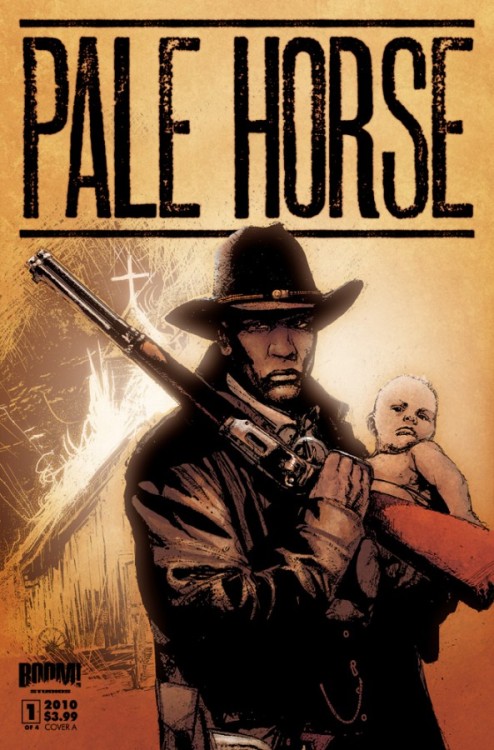
Boom! Studios presents what it considers a new take on the Western genre, with it's mini series, Pale Horse. Maybe this will be the comic book version of Posse meets Rosewood?
PALE HORSE tells the tale of ex-slave and former Union soldier Cole, who has spent the years following the Civil War building a reputation as the most fearsome bounty hunter in the land. But when the tables turn and a bounty is placed on Cole’s head, all hell breaks loose. Finding himself unable to protect the thing most precious to him — his family — Cole goes on a rampage of revenge, leaving only a trail of blood in his wake. With nothing but his horse, his one surviving son and his gun, Cole’s rampage leaves no stone unturned and no culprit alive.
Labels:
Black Cinema,
Comics,
Random Geekery,
S.T.M.I.O.M.
Friday, March 26, 2010
Afrolatinos: The Untaught Story
Afrolatinos “The Untaught Story” is a documentary television series independently produced by Creador Pictures, LLC. The program will illustrate history and celebrate the rich culture of people in Latin America of African descent. From the story of how and when slaves came to Central and South America to identity issues that still exist in the Hispanic community today. There are an estimated 200 million Afro-descendants in Latin America but the majority of them do not have political or economic power. This documentary takes you on a journey to meet Afrolatinos throughout Spanish and Portuguese speaking nations and an exploration and appreciation of their culture. It will also teach the uninformed and hopefully initiate social change throughout Latin America.
The documentary series will begin with the slave trade in the early 1500’s and touch on the Cimarron (Palenque) communities, as well as cover the controversial theory of the African presence in ancient America. The programs quest is to better understand the religious connections and distinctions between the Catholic Church and religious practices such as Yoruba and Voodoo. We learn about these religious and sacred ceremonies through dance and music. The drum is a very significant instrument used in Latin music today but do many people know its history? The documentary will have a segment on Afro-Latin gastronomy, which will show the many dishes with African influence as seen in Latino every day life.
Today, there still exists communities where African dialects were mixed with Spanish language found in places like San Basilio de Palenque and we’ve discovered a dictionary of Spanish words of African origin. Identity will be a special segment that affects millions of black Latinos worldwide. Of all the issues that are affecting their way of life the main issue is the exclusion of a community of people based on the color of their skin. We interview people from the U.S to Argentina about issues such as image (this idea of good hair, bad hair), interracial marriages, racism, oppression, exploitation and Afrolatinos consciousness plus much more.
One of the most important chapters in the documentary is the social issues segment as it is directly affecting ALL Afrolatinos communities. Our producers not only document the problems but also live and experience it firsthand. Consistent in most of the countries visited was the lack of local government support; from corruption to discrimination Afrolatinos endear many tribulations. We hope this documentary will empower its Afro brothers and sisters and encourage people to help one family at a time, give voice to the invisible, create awareness, start a dialogue and promote change.
Source: AfroLatinos.tv
Labels:
Black Cinema,
Black Community,
Latino Community,
Race
Saturday, November 28, 2009
An Interesting Look At Oprah & Tyler Perry's Precious
A film as lost as the girl it glorifies
By Courtland Milloy
Now that I have seen the movie "Precious: Based on the Novel 'Push
' by Sapphire," I'm all the more bewildered by its enthusiastic reception, especially in the white media. The fictional story revolves around a black teenager, Claireece "Precious" Jones, who is raped by her father, gets pregnant by him -- twice -- and endures the depravity of her psychopathic mother.
The Huffington Post raved: "This is a film that doesn't shy away from the depths to which human beings can sink. . . ." You'd think the movie was a documentary.
The independent film, directed by Lee Daniels and adapted from a 1996 novel by the poet Sapphire, raked in an impressive $6 million during its weekend debut. Little wonder, though, given all the media buzz.
The New York Times Magazine featured the movie as a cover story last month and declared: "Precious is a stand-in for anyone -- black, white, male, female -- who has ever been devalued or underestimated."
Let's see: I lose my job, so I take in a movie about a serially abused black girl and I go, "Oh, swell, she's standing in for me."
Maybe there is something to the notion that when human pathology is given a black face, white people don't have to feel so bad about their own. At least somebody's happy.
Sexual abuse is certainly an equal-opportunity crime, with black and white women similarly affected. But only exaggerated black depravity seems to resonate so forcefully in the imagination.
White suburban boys are so fascinated by it that they fueled an explosion of gangsta rap -- misogynistic lyrics against a backdrop of booty-shaking black women.
Of course, "Precious" would not have received nearly as much media buzz if Oprah Winfrey and Tyler "Madea" Perry had not signed on as executive producers. Oddly, neither has made a movie about rising above a challenging background and becoming a wealthy and influential entertainer.
Asked by Entertainment Weekly magazine why she got involved with the project, Oprah said: "I realized that, Jesus, I have seen that girl a million times. I see that girl every morning on the way to work, I see her standing on the corner, I see her waiting for the bus as I'm passing in my limo, I see her coming out of the drugstore, and she's been invisible to me."
Instead of making a movie about how she beat the odds, Oprah has taken to divining ugly life stories from black girls she passes in her limo. Maybe the Obama girls should stay off the sidewalk for a while.
In "Precious," Oprah and Perry have helped serve up a film of prurient interest that has about as much redeeming social value as a porn flick. In it, we glimpse a sweaty, faceless brute of a black man raping the girl while her mother watches from a doorway. Two children are conceived in incest.
"The Jones family home is an amber-lit hell, and we're not initially sure whether Precious is a prisoner or a participant in it," says Time magazine. "The movie allows moments of judging Precious . . . then begins to roll out a series of nightmares that last the whole day long: rape, incest and a mother so lacking in human decency that she not only aided in a father's lust for a child but also considered the child as a witting rival."
Rolling Stone gave "Precious" 3.5 stars out of four. Three X's would be more like it.
I watched the movie at a theater in Alexandria where showtimes are nearly around the clock, from 10:15 a.m. to 12:15 a.m. The audience was mostly black women and teenagers. When the lights came up, all of the moviegoers appeared sullen and depressed.
After escaping the abuse of her home life, Precious ends up in a halfway house. She is still functionally illiterate and has two babies to care for, one with Down syndrome.
Strangest of all, many reviewers felt the movie ended on a high note. Time, for instance, wrote that Precious "makes an utterly believable and electrifying rise from an urban abyss of ignorance and neglect."
Excuse me, the movie ends with the girl walking the streets, babies in her arms, having just learned that her father has died of AIDS -- but not before infecting her.
The story is set in 1987, before AIDS treatment became widely available. Precious is as good as dead.
At the Cannes Film Festival, members of a mostly white audience gave "Precious" a 15-minute standing ovation.
I guess they can hardly wait for the sequel.
By Courtland Milloy
Now that I have seen the movie "Precious: Based on the Novel 'Push
The Huffington Post raved: "This is a film that doesn't shy away from the depths to which human beings can sink. . . ." You'd think the movie was a documentary.
The independent film, directed by Lee Daniels and adapted from a 1996 novel by the poet Sapphire, raked in an impressive $6 million during its weekend debut. Little wonder, though, given all the media buzz.
The New York Times Magazine featured the movie as a cover story last month and declared: "Precious is a stand-in for anyone -- black, white, male, female -- who has ever been devalued or underestimated."
Let's see: I lose my job, so I take in a movie about a serially abused black girl and I go, "Oh, swell, she's standing in for me."
Maybe there is something to the notion that when human pathology is given a black face, white people don't have to feel so bad about their own. At least somebody's happy.
Sexual abuse is certainly an equal-opportunity crime, with black and white women similarly affected. But only exaggerated black depravity seems to resonate so forcefully in the imagination.
White suburban boys are so fascinated by it that they fueled an explosion of gangsta rap -- misogynistic lyrics against a backdrop of booty-shaking black women.
Of course, "Precious" would not have received nearly as much media buzz if Oprah Winfrey and Tyler "Madea" Perry had not signed on as executive producers. Oddly, neither has made a movie about rising above a challenging background and becoming a wealthy and influential entertainer.
Asked by Entertainment Weekly magazine why she got involved with the project, Oprah said: "I realized that, Jesus, I have seen that girl a million times. I see that girl every morning on the way to work, I see her standing on the corner, I see her waiting for the bus as I'm passing in my limo, I see her coming out of the drugstore, and she's been invisible to me."
Instead of making a movie about how she beat the odds, Oprah has taken to divining ugly life stories from black girls she passes in her limo. Maybe the Obama girls should stay off the sidewalk for a while.
In "Precious," Oprah and Perry have helped serve up a film of prurient interest that has about as much redeeming social value as a porn flick. In it, we glimpse a sweaty, faceless brute of a black man raping the girl while her mother watches from a doorway. Two children are conceived in incest.
"The Jones family home is an amber-lit hell, and we're not initially sure whether Precious is a prisoner or a participant in it," says Time magazine. "The movie allows moments of judging Precious . . . then begins to roll out a series of nightmares that last the whole day long: rape, incest and a mother so lacking in human decency that she not only aided in a father's lust for a child but also considered the child as a witting rival."
Rolling Stone gave "Precious" 3.5 stars out of four. Three X's would be more like it.
I watched the movie at a theater in Alexandria where showtimes are nearly around the clock, from 10:15 a.m. to 12:15 a.m. The audience was mostly black women and teenagers. When the lights came up, all of the moviegoers appeared sullen and depressed.
After escaping the abuse of her home life, Precious ends up in a halfway house. She is still functionally illiterate and has two babies to care for, one with Down syndrome.
Strangest of all, many reviewers felt the movie ended on a high note. Time, for instance, wrote that Precious "makes an utterly believable and electrifying rise from an urban abyss of ignorance and neglect."
Excuse me, the movie ends with the girl walking the streets, babies in her arms, having just learned that her father has died of AIDS -- but not before infecting her.
The story is set in 1987, before AIDS treatment became widely available. Precious is as good as dead.
At the Cannes Film Festival, members of a mostly white audience gave "Precious" a 15-minute standing ovation.
I guess they can hardly wait for the sequel.
Labels:
Black Cinema,
Black Community,
Race
Friday, August 21, 2009
Chris Rock & Friends Discuss "Good Hair"
Sarah Jones & executive producer Nelson George join Rock to discuss his upcoming documentary Good Hair.
Labels:
Black Cinema,
Black Community,
Chris Rock,
Man Crush
Friday, July 24, 2009
Chris Rock's Good Hair Promo
Labels:
Black Cinema,
Black Community,
Chris Rock,
Man Crush
Thursday, July 9, 2009
IFC's 50 Greatest Movie Trailers
The Independent Film Channel has put together an interesting list. They took the time to rank the 50 greatest movie trailers of all time. I was definitely left scratching my head with 2 of the top 5 choices, but I thought I would share some of my favorites that made the list.
48. The Watchmen
36. The Banned Spider Man Trailer
35. The Lord Of The Rings
32. The Matrix
22. Sin City
20. She's Gotta Have It
15. Pulp Fiction
09. Mission: Impossible
03. Cloverfield
Here's IFC's complet list.
Thanks for stopping by,
8
Labels:
Black Cinema,
Comics,
movies,
Spider Man,
The Lord of the Rings
Wednesday, July 1, 2009
8 @ The Movies: 2 Reviews/1 Movie

A few weeks ago I went to see Away We Go, which stars SNL alum Maya Rudolph along with John Krasinski of The Office.
Here's a brief synopsis of the movie if you couldn't check the trailer I linked to:
"Longtime (and now thirtysomething) couple Burt (John Krasinski) and Verona (Maya Rudolph) are going to have a baby. The pregnancy progresses smoothly, but six months in, the pair is put off and put out by the cavalierly delivered news from Burt’s parents Jerry and Gloria (Jeff Daniels and Catherine O’Hara) that the eccentric elder Farlanders are moving out of Colorado – thereby eliminating the expectant couple’s main reason for living there." - FilmInFocus.com
The reason I titled this blog 2 Reviews/1 Movie, is because I have ambivalent feelings about this movie. I guess I should give the bad news first.
The Social Review:
I first must disclose that I have a bit of a crush on Maya Rudolph. I think it's primarily because she's funny. I tend to like funny women, so that may taint this review.
Anyway, one of the things that really irked me about this movie was the fact that conveniently her parents are both dead. I say conveniently because we've seen this same song & dance with another biracial actress recently, Rashida Jones. They killed her parents off in I Love You, Man, which is kind of a big deal in a movie about a wedding. Hell, the bride's father typically pays for the wedding, right? The Root, briefly touched on this whitewashing in their article, Rashida Jones & The Hollywood Shuffle.
I feel race shouldn't be the issue in movies, but it should exist. They conveniently killed off her family for the sake of the movie. Both Rashida & Maya's race were the giant elephant in the room to me. At least in Away We Go, they did have a character ask if the baby would be Black in passing. Also, they gave Maya's character a sister in the form of Carmen Ejogo, but she was in and out of the movie in a blink. Plus, her skin seemed to be lighter than I had ever seen it and the character was supposed to be living in Arizona.
I guess I was just hoping for a slightly more diverse cast since one of the leads happened to be biracial. Black actors need some love, too. lol
The Entertainment Review:
It was weird watching the trailers & seeing the movie posters leading up to actually watching the film. Going into it, I really wasn't sure if this thing was a comedy or drama. I know the two leads are known for comedy, but the trailers left me with the impression that the movie was a drama with funny moments. It turned out to be a pretty straightforward comedy.
I saw it as a more realistic and funny Dumb & Dumber. I compare it to that movie because both of the lead characters seemed pretty vapid to me. I know the characters of Dumb & Dumber were full of life, but they were empty headed. These two leads seemed just as empty headed. Why are they living in an shack without heat? Why are they so concerned that his parents are going on a vacation? The soon to be grandparents weren't the sharpest pencils in the box, themselves. A couple in their early to mid-thirties that's expecting their first child decides to live like this? If they have the money to zig-zag across the country, why didn't they use this money for a decent place to live? Why does Maya not want to marry John, but feel he's good enough to be the father to her child? I wanted to shake the hell out of both Maya & John's characters at times.
The road trip that you witness throughout the rest of the movie is pretty funny, but the first couple they visit kind of steals the film. I never laughed harder than when Allison Janney & Jim Gaffigan's characters were on screen. Think Al & Peg Bundy uncensored with Peg on speed & Al drunk.
Overall it was a very entertaining movie, with a pretty dumb ending. When you see the ending the first thing you will say to yourself is probably, "Why didn't they do that in the first place?"
Thanks for stopping by,
8
Labels:
Black Blogs,
Black Cinema,
Maya Rudolph,
movies,
Race,
Rambling Man,
Rashida Jones
Tuesday, June 2, 2009
Precious (aka Push)
In this inner-city horror story, newcomer Gabourey Sidibe plays Clarice, a pathetic ghetto girl enduring more personal plagues than Job. Called "Precious," she's illiterate, overweight and emotionally abused by her deadbeat mother (Mo'Nique). Slow in school, Precious wallows in junior high at 16 and is shuffled through the system to a "special" program.
Shoving her boxcar frame into the bleak makeshift classroom, Precious confronts the first ray of help in her life, a charismatic teacher called Blu Rain (Paula Patton). With Blu Rain's feisty prodding, Precious slogs toward her GED.
Precious sustains herself through intermittent fantasies. She envisions herself as the worshipful object of mass media's most vapid idealizations: a red-carpet superstar and, most shockingly, a blonde-haired/blue-eyed white beauty queen. That weird warp is darkly ironic; from the outside it seems the ultimate degradation to Precious. Yet, those oddly inspired flights are the sole windows of self-esteem and sustenance for this degraded girl. - The Hollywood Reporter
Labels:
Black Cinema,
Black Community,
movies
Subscribe to:
Posts (Atom)